by Lynn Pechuekonis, Chair
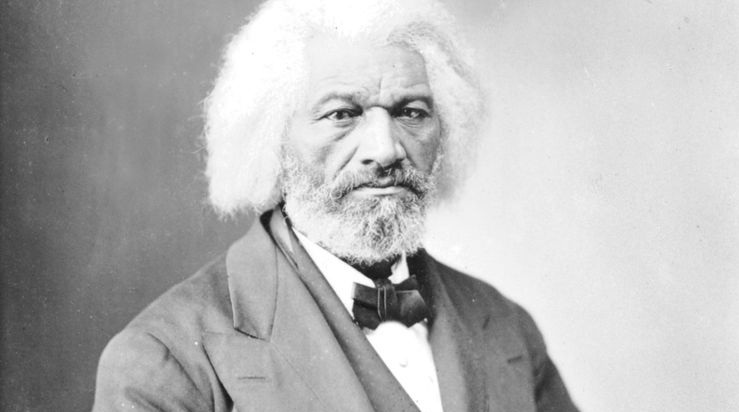
There was an era when the great Frederick Douglass walked the streets of Harpers Ferry with surprising frequency.
Our town is so small that when I learn about a historical figure visiting here, it feels like a big deal — almost personal. I’ve recently been learning about Frederick Douglass’s visits here. Harpers Ferry was a place of deep historical significance to him, a place where he could promote racial uplift through education, and a place of beauty where he could rest and relax.
Douglass was an early supporter of Storer College, established here in 1867. He served on its board of trustees for several years and presumably attended an annual meeting or two in person.
His most publicized visit to the Ferry was in 1881, when he was the featured speaker at the school’s fourteenth anniversary commencement celebration. The purpose of his speech was twofold: (1) to vindicate John Brown, the fallen hero of Harper’s Ferry, and (2) to raise funds to establish a John Brown professorship at Storer College. A WVU blog post by Jane Metters LaBarbara describes the speech this way:
Douglass, by re-examining the life and passion of John Brown, revealed a deeper connection to Brown’s strike at Harper’s Ferry as the initial blow that led to the Civil War, and a blow struck in the death of slavery. After Douglass’ speech, Brown appears less the zealous fanatic to the nation and more the revolutionary. Newspapers across the country reported on the effects of this speech. Though still a figure that remains clouded, our perception of John Brown is forever altered by this speech, surrounded by the cloak of Douglass’ remembrance, and enlightened by his impassioned oration. (News | WVU Libraries)
This man, who was a central figure in the fight for equality and justice in the US, dropped into Harpers Ferry and made a major impact with his speech that summer, but he returned at least twice later in the decade.
Summer 1884
Douglass had been widowed in 1882 then married Helen Pitts, his former secretary, in January 1884. The following summer, perhaps to acquaint the new Mrs. Douglass with one of his favorite places, he brought her to town. A reporter happened across the couple on the train enroute to their Harpers Ferry “pilgrimage” but was more interested in describing Douglass’ new White wife than reporting the purpose of their visit. The fact that his sons Charles and Lewis were spending the summer here may have had some bearing on the timing of their visit. Perhaps they needed a bit of a vacation break. Although I’ve found no specific documentation, the Douglasses most likely all boarded in Lincoln Hall on the Storer campus. The summer boarding accommodations were segregated at that time.
Sources: Article reprinted in the Douglas Independent (Roseburg, Ore.), July 19, 1884, p. 1; see also The Washington Bee, June 28, 1884.
Summer 1885
The Douglasses returned to Harpers Ferry in 1885, this time with Helen’s mother, for a Storer commencement where Episcopal minister Alexander Crummell delivered the keynote address.
“An excursion train from Washington unloaded several hundred smartly dressed colored folks from the capital to add eclat to the educational event,” reported the St. Louis Globe Democrat. “Fred Douglass was among them.” After stopping for a moment to point out John Brown’s Fort to his companions, Douglass hailed a hack (driven by a white man, the reporter noted), and was driven uphill to Storer College to deliver his own words of wisdom to the graduates.
The final paragraph of the news article, though not about Douglass, provides interesting insight about Harpers Ferry at that time—a history I am currently working to highlight in ongoing research:
The colored people have captured the Ferry and are in a fair way to hold it. They are the best dressed residents of the scattered town, and live in the best houses. … They have large yards about their houses, full of flowers, and their well-tilled fields stretch away over the hills beyond the town of Bolivar. (St. Louis Globe Democrat, July 4, 1885, p. 5)
Post-1885
The Douglasses spent September 1886 – May 1887 on a Grand Tour. Frederick served in Haiti much of 1889-1991. He may have found time for an additional visit to Harpers Ferry, but if so, it was not widely reported in newspapers. In 1894 he headlined a committee to raise funds for a John Brown Monument in Harpers Ferry, along with Storer president Nathan Brackett and Hill Top House owner Tom Lovett. It’s unclear, though, where the committee held its meetings. Since the remainder of committee members were prominent Black men from Washington, DC, it’s more likely they met in the city.
On February 20, 1895, the great Frederick Douglass, who made such a significant mark on our country’s history, passed away. Among the papers found in his office at Cedar Hill was a flyer advertising the Hill Top House, which opened in 1890. He was well aware of his friend’s success, although he probably never had the opportunity to stay there.
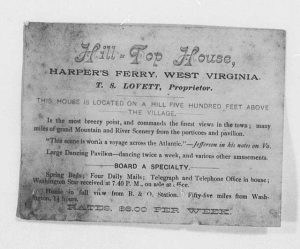
LOC
Note: This information in this post was gleaned from my own research. My thanks to author John Muller for prompting me on this subject and providing helpful background details. He wrote the book, Frederick Douglass in Washington, D.C.: The Lion of Anacostia. (Rev. 2/24/25)
 HF Black History Featured in Prince William Living Magazine
 To Betsy
 Honor Awarded to Local Historic-Neighborhood-Sensitive New Construction