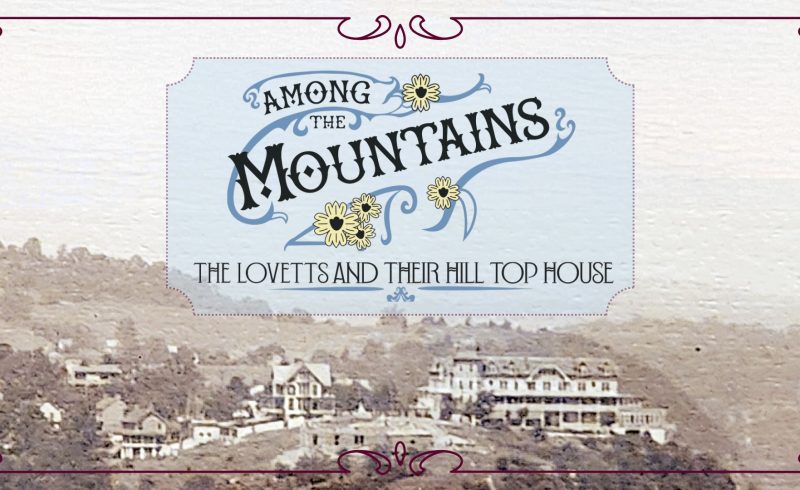
In 1890 an enterprising Black couple bought a prized plot of land in Harpers Ferry and built an incredibly successful summer resort hotel and restaurant serving an exclusively White clientele. It was extremely popular with the Washington-Baltimore crowd for the 35 years it was owned by the Lovetts. After they sold it in 1926, the hotel lived on through subsequent owners until 2008, when it was closed due to structural deficiencies, then deconstructed in 2022.
The Harpers Ferry Park Association has recently published a book on the Lovett family, written by local historian and current Foundation chair, Lynn Pechuekonis. Here is a brief interview with her:
What interested you in writing about this family who founded the Hill Top House?
Lynn: The contemporary Hill Top House has long been a beloved destination for thousands of people within a 100-mile radius of Harpers Ferry. Yet, few people knew that it was founded by a Black family in 1890. If they knew anything about the Lovett family, it was superficial and largely inaccurate. I thought the Lovetts deserved better. They were remarkable people, and I wanted to get to know them.
How was it possible for a young Black couple to build their own hotel in a place like Harpers Ferry at the onset of the Jim Crow era?
Lynn: Several factors contributed, but two stand out to me:
What was your most surprising finding?
Lynn: Of course, the financial connection between the Lovetts and local White investors was a big one. All the stereotypes I expected to see played out between former Confederates and an enterprising Black couple in Jefferson County were exploded by this long-term partnership.
Second was the strong influence exerted by Mrs. Lovett’s experience. Lavinia was brought up as a family member in a Northern White household under the mentorship of an influential and wealthy abolitionist woman. She knew people of note, like poet John Greenleaf Whittier. She was educated in White schools and was the second Black woman ever to earn a skilled nursing degree. She had plenty of experience and knowledge of the privileged White world, which informed their operation of the Hill Top House. Lavinia, their two daughters, Tom’s mother and grandmother—strong women played a major role in this story.
You discovered that the Lovetts were well connected with members of the Black elite in Washington DC. Who did they interact with there?
Lynn: Probably the most famous was Frederick Douglass. Tom Lovett served on a committee with Douglass to establish a John Brown monument in Harpers Ferry, and he also interacted with the Douglass sons. The Lovetts spent many winters in DC and sent their two daughters to M Street High School. Their social circle included the Terrells, the brothers Henry and Winfield Montgomery, former Mississippi Senator Blanche K. Bruce, and Daniel and Anna Murray. They attended 15th Street Presbyterian Church, pastored by Rev. Francis Grimke, so they also rubbed elbows with the elite families who worshipped there.
Who were some of the most notable patrons served by the Lovetts at the Hill Top?
Lynn: Probably not who you think. The most prominent was President Woodrow Wilson and his second wife Edith Galt Wilson. They came once for lunch while they were dating and once for dinner after they married. They never stayed overnight, but several members of his cabinet followed up with visits.
Vincent Astor, heir to the John Jacob Astor fortune. Much earlier, Congressman Thomas Dunn English. Authors Jack Bechdolt and Decie Merwin.
Mark Twain most likely did not visit the Hill Top. No confirmation can be found of his visit to Harpers Ferry after the Hill Top House opened, and the first claim of a visit didn’t appear until the 1950s. The claims that Alexander Graham Bell appeared in Hill Top marketing even later—the 1960s or 70s—but there is no independent confirmation of his visit either. W.E.B. DuBois was not likely to have stayed at the Hill Top House, even though he was definitely in Harpers Ferry on three different occasions.
Carl Sandburg visited sometime in the 1920s. Author Pearl S. Buck did visit in 1970 and President Bill Clinton in 1998.
The hotel burned down twice. Was foul play involved? Was someone trying to ruin their business?
Lynn: People have occasionally posited that theory, but there is no evidence of either fire being purposely set. The 1912 fire happened on a very breezy December afternoon, and Lovett said it started with a brush fire in the garden. Seven years later, the second fire started in a guest room on a June morning during breakfast. Neither time was foul play suggested in the newspapers. Also, both times, neighbors came from all around to rescue furniture, equipment, and supplies from the flames. And immediately after the fire, there was huge support in the local business community for rebuilding, because the hotel’s success had considerable positive impact on the town’s and the region’s commercial interests. The Lovetts were very well respected, in general, and always supported in the local White press.
The launch party and official book signing for Among the Mountains: The Lovetts and Their Hill Top House is scheduled for Saturday, September 13, 2025, 6 pm, at the old Hill Top overlook. Register here: https://www.zeffy.com/en-US/ticketing/among-the-mountains-the-lovetts-and-their-hill-top-house-official-book-launch
 HF Black History Featured in Prince William Living Magazine
 To Betsy
 Honor Awarded to Local Historic-Neighborhood-Sensitive New Construction